BLOG
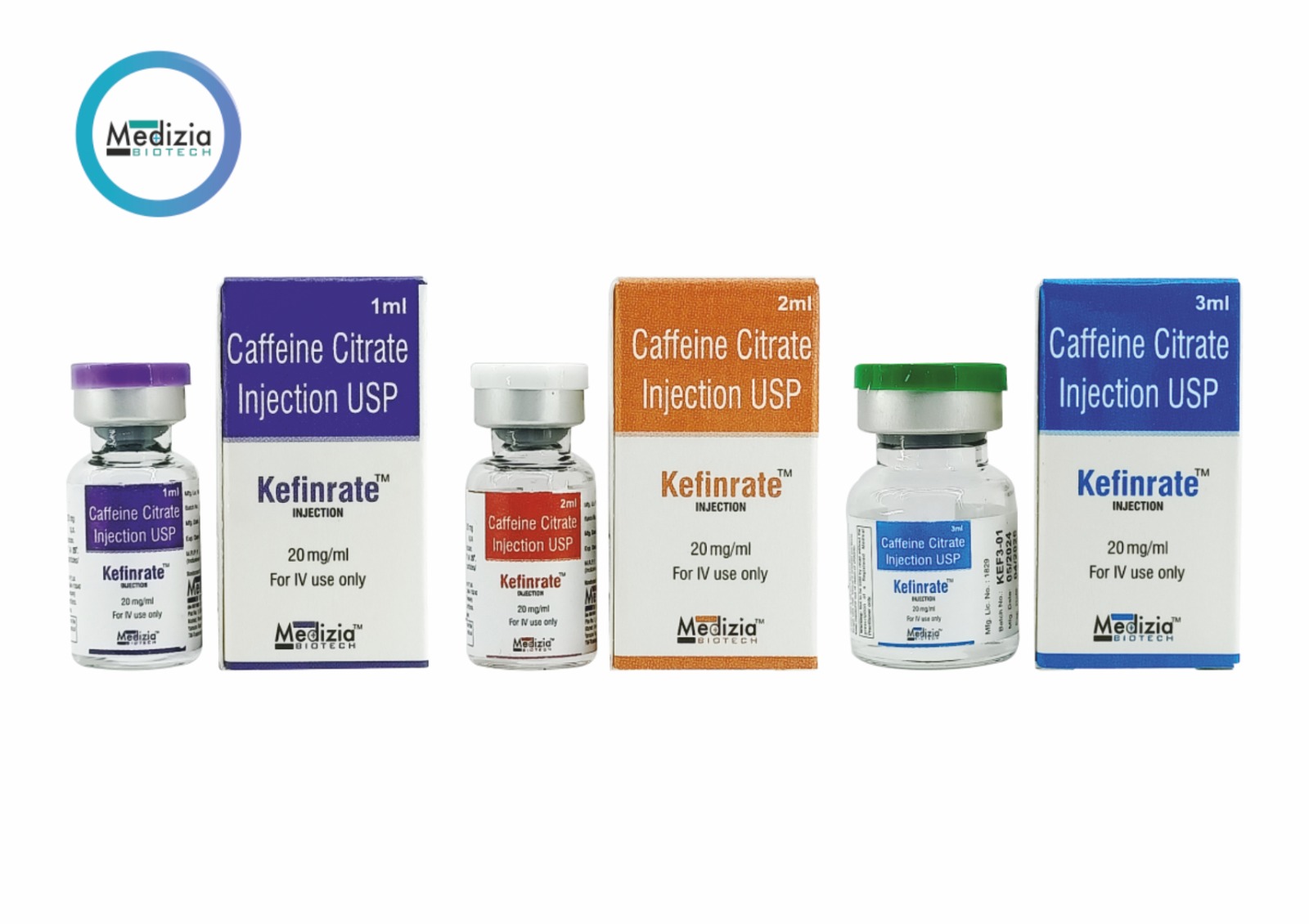
Caffeine Citrate Injection Manufacture in India by Mediziabiotech 1ml 2ml 3ml
Caffeine Citrate Injection Manufacture in India by Mediziabiotech 1ml 2ml 3ml
The Clinical Imperative: Why Caffeine Citrate Dominates Neonatal Care
Every premature infant admitted to a neonatal ICU arrives at one of the most critical crossroads in human medicine — where the smallest patients face the highest stakes.
Apnea of Prematurity (AOP) affects up to 85% of infants born before 34 weeks gestation, making it one of the most urgent conditions in neonatal critical care. When a premature infant stops breathing — sometimes dozens of times per day — every second without intervention risks brain injury or death. Caffeine citrate injection has become the frontline pharmacological response to this crisis, functioning as a central nervous system stimulant that directly activates brainstem respiratory centers by blocking adenosine receptors.
As the Journal of Pediatric Pharmacology and Therapeutics notes:
"Caffeine citrate remains the most commonly used pharmacological treatment for apnea of prematurity because of its proven efficacy in reducing the need for mechanical ventilation."
Compared to older treatments, caffeine citrate offers a dramatically superior safety profile and measurable clinical outcomes — including reduced reliance on invasive ventilation, which carries its own serious risks for fragile neonatal lungs. This clinical superiority over alternatives isn't just academic — it shapes every procurement decision made in neonatal units across India. Understanding why one treatment outperforms another also determines which distribution partners genuinely serve critical care needs, a distinction that comes into sharp focus when comparing caffeine citrate to older methylxanthine-class drugs.
Caffeine Citrate vs. Theophylline: The Procurement Perspective
Choosing between neonatal respiratory drugs isn't just a clinical decision — it's an operational one that directly shapes NICU workflow, staff burden, and patient safety outcomes.
Caffeine citrate injection uses extend well beyond apnea management; its pharmacokinetic profile makes it fundamentally easier to administer, monitor, and procure at scale compared to theophylline.
|
Feature |
Caffeine Citrate |
Theophylline |
|---|---|---|
|
Half-life |
72–100 hours (once-daily dosing) |
20–30 hours (multiple daily doses) |
|
Therapeutic Index |
Wide — lower toxicity risk |
Narrow — higher toxicity risk |
|
Blood Level Monitoring |
Reduced frequency needed |
Frequent monitoring required |
|
Dosing Complexity |
Straightforward |
Higher risk of dosing errors |
The American Academy of Pediatrics confirms caffeine citrate's preference over theophylline specifically because of its longer half-life and wider therapeutic index. In practice, this translates directly into procurement advantages: hospitals stock one predictable formulation rather than managing the safety infrastructure theophylline demands.
Reduced monitoring frequency is particularly meaningful in resource-constrained NICUs. Fewer blood draws mean less staff time, lower lab costs, and reduced stress on fragile infants. For procurement teams sourcing critical care injectable solutions, this operational simplicity makes caffeine citrate the rational default choice.
Understanding why this drug wins clinically sets the foundation for getting the dosage protocols exactly right.
Dosage and Administration: Precision in Critical Care
Getting the caffeine citrate injection dose right is not optional — in neonatal care, every milligram carries clinical consequence.
Dosing Protocol: According to the WHO Model List of Essential Medicines, caffeine citrate follows a structured two-phase protocol that NICU teams must execute with precision:
-
Loading dose: 20 mg/kg of caffeine citrate administered intravenously over 30 minutes
-
Maintenance dose: 5–10 mg/kg once daily, beginning 24 hours after the loading dose
-
Route: Intravenous infusion via syringe pump for controlled delivery in NICU settings
-
Duration: Continued until the infant reaches approximately 33–34 weeks corrected gestational age
Concentration matters enormously. In pediatric injectables, even minor formulation inconsistencies can shift outcomes. Sourcing from quality-certified injectable manufacturers helps ensure consistent drug concentration across every vial.
Dosage Note: Despite caffeine citrate's notably wide therapeutic index compared to theophylline, monitoring serum caffeine levels, heart rate, and glucose remains standard clinical practice — particularly when doses are adjusted.
What makes this drug operationally attractive goes beyond its clinical profile. That predictable, protocol-driven demand creates a compelling procurement story — one that distributors and supply chain stakeholders are increasingly paying attention to.
The Business Case: Why Distributors are Prioritizing Neonatal Injectables
Stable, non-negotiable demand makes injection caffeine one of the most commercially resilient products a pharma distributor can carry in India today.
Essential Medicine status = predictable revenue. Caffeine citrate's inclusion on the WHO Model List of Essential Medicines signals something distributors value above all else: institutional demand that doesn't fluctuate with trends. Every level-II and level-III NICU in India is effectively a guaranteed reorder point. Hospitals don't deprioritize drugs listed as essential — procurement teams budget for them as fixed costs.
Market growth adds a tailwind. The global pediatric medicines market is expanding significantly, with caffeine citrate recognized as a frontline essential for neonatal respiratory distress. India's rising preterm birth rates — and the parallel growth of private NICU infrastructure — translate directly into expanding distributor territories and repeat purchase cycles.
Low-risk investment profile. Unlike lifestyle or elective-use products, neonatal injectables face near-zero demand erosion. A distributor stocking this product isn't speculating — they're fulfilling a clinical obligation that hospitals cannot defer. That's a fundamentally different risk profile.
High barriers protect early movers. Manufacturing sterile injectables at the quality level NICUs require isn't accessible to every player. Partnering with a certified injectable manufacturer narrows the competitive field considerably — and that manufacturing rigor is exactly what the next consideration demands.
Quality Benchmarks: The Role of WHO-GMP in Critical Care Manufacturing
In neonatal injectables, manufacturing quality isn't a compliance checkbox — it's the difference between a safe dose and a life-threatening error.
Critical care injectables demand higher purity standards than most pharmaceutical categories. A neonatal patient weighing under 1,000 grams has virtually no tolerance for particulate contamination, endotoxins, or dosing inconsistencies. Even minor deviations in sterility or concentration can cause irreversible harm to developing organ systems.
The risks of sub-standard manufacturing are well-documented across the industry. Improperly compounded injectables have been linked to infection clusters and dosing failures in NICUs — outcomes no distributor or hospital can afford. As caffeine citrate injection uses expand across Hindi-speaking regions of India, where awareness of caffeine citrate injection uses in Hindi is growing among frontline nursing staff, ensuring product integrity at the source becomes even more critical.
What to look for in a PCD Pharma partner:
-
WHO-GMP certification — validates internationally recognized manufacturing processes
-
DCGI approval — confirms regulatory compliance within India's drug authority framework
-
ISO certification — signals consistent quality management systems
-
Validated sterile fill-finish lines — essential for all injectable formulations
-
Third-party quality audits — adds an independent layer of accountability
Medizia Biotech operates under strict WHO-GMP and DCGI certifications, with manufacturing infrastructure designed specifically for injectable formulations. That level of rigor is what separates a reliable supply chain partner from a liability risk.
When you understand what genuinely separates one caffeine citrate product from another, the bigger picture of why this molecule has become indispensable in neonatal care comes sharply into focus.
The Bottom Line: What You Need to Know About Caffeine Citrate
Caffeine Citrate isn't just another neonatal drug — it's the clinically proven, WHO-backed standard of care that every NICU depends on, making it a non-negotiable product for any serious critical care distributor.
Here's what the evidence consistently shows:
-
Primary AOP treatment: Caffeine Citrate manages apnea of prematurity in approximately 85% of preterm infants, making it the dominant therapeutic choice across NICUs globally.
-
Clinically superior to alternatives: Comparative studies confirm Caffeine Citrate outperforms Theophylline on every practical metric — a wider safety margin, simpler once-daily dosing, and significantly fewer adverse effects.
-
Essential Medicine status: Its inclusion on the WHO Essential Medicines List isn't a distinction — it's a demand guarantee. Hospitals are required to stock it, which means your inventory moves predictably.
-
Source quality determines supply reliability: For distributors building a PCD pharma franchise critical care portfolio, sourcing from WHO-GMP and ISO 9001:2015 certified manufacturers is the single most important decision affecting long-term franchise viability.
The takeaway is straightforward: clinical necessity, regulatory backing, and consistent hospital demand create an unusually low-risk, high-value product category. However, not all supply chains are equal — and choosing the wrong manufacturer introduces quality and continuity risks that no margin can offset. That's precisely why evaluating your manufacturing partner's certifications, sterile processing capabilities, and injectable production standards should be your next step.
Securing Your Supply Chain for Critical Care Injectables
Clinical excellence and franchise growth converge at one point: a manufacturer whose quality standards are non-negotiable, no matter the order volume.
When evaluating a partner for neonatal critical care distribution, the product portfolio tells the full story. Look for a manufacturer with verified WHO-GMP injectable manufacturing credentials, a documented cold-chain protocol, and an established range covering critical-care injectables — not just a single SKU. Medizia Biotech's neonatal and critical care injectable portfolio demonstrates exactly this depth, with Caffeine Citrate available in 1ml, 2ml, and 3ml formats ready for franchise partners across India.
For hospital procurement teams and PCD distributors, the next step is straightforward:
-
Audit certifications — confirm WHO-GMP compliance and drug license validity before signing any agreement
-
Request stability data — sterile injectables require documented shelf-life and storage evidence
-
Evaluate supply consistency — ready stock availability directly impacts NICU patient outcomes
Quality over commodity pricing is the final, non-negotiable principle here. A few rupees saved per vial means nothing if a batch recall disrupts supply to a premature infant's care team. Explore trusted injectable manufacturers before committing to any franchise arrangement.
The right distribution partnership doesn't just grow your business — it protects the smallest, most vulnerable patients at the center of it all.